Analyzing My Digital Identity
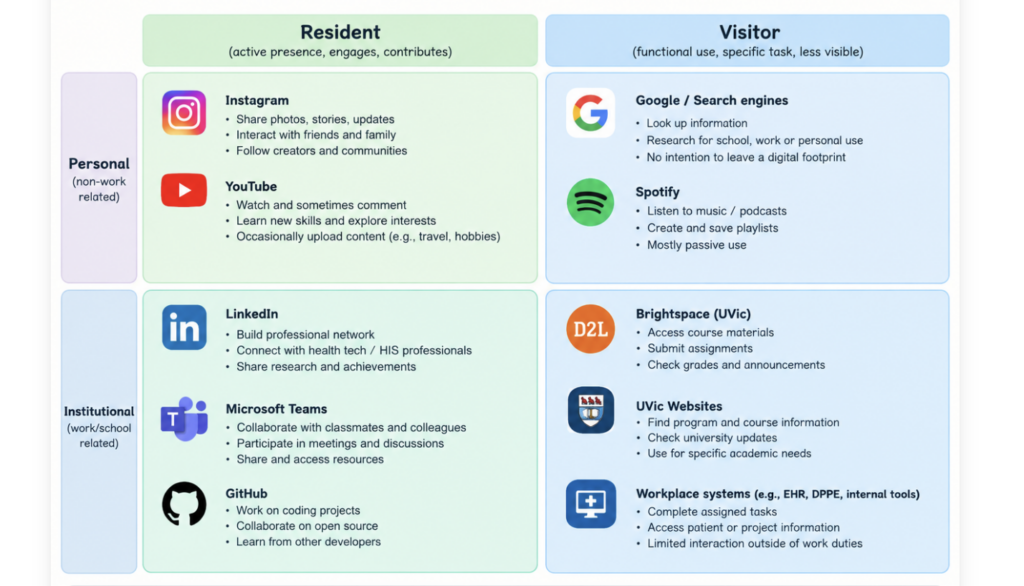
When I completed my Visitors and Residents map, I realized that my digital identity changes depending on what I am using technology for. As a Health Information Science student, I use different platforms for school, work, research, and my personal life, and I do not interact with all of them in the same way. Some platforms are more like being a “Visitor,” where I log in, complete a task, and leave. Others are more like being a “Resident,” where I regularly interact with people and build a digital presence. This made the Visitors and Residents framework feel relevant to my own experience because the same technology can be used very differently depending on the purpose.
LinkedIn is probably where I am most intentionally a Resident. Since I am interested in health informatics, health technology, and AI in healthcare, I use LinkedIn to follow researchers, healthcare organizations, and professionals in the field. My co op experiences in healthcare technology and my research experience at UVic have also made LinkedIn more meaningful to me. I have been able to share some of my research and professional experiences, including my work in clinical information systems and AI in health. Connecting with people in the health information field has also helped me see LinkedIn as more than just a place to look for jobs. It has become part of how I learn about the field I want to work in.
My experience with research has also changed how I use digital platforms. For example, I regularly use tools such as PubMed, Zotero, and other research databases to find and organize information. I would consider many of these more Visitor-like because I usually have a specific research task in mind. However, when I communicate with researchers, collaborate on projects, or share research findings, I become more of a Resident because I am contributing to a professional community rather than simply finding information.
Instagram is different for me because it is primarily personal. I use it to stay connected with friends and share parts of my life outside of school and work. At the same time, I have realized that my personal social media can still contribute to my overall digital identity. Someone who knows me professionally could potentially see my personal account, so there is still a connection between the different parts of my online presence.
I think I could expand my professional learning network by becoming more active outside of my university. My experiences with co-op and healthcare organizations have shown me that some of the most useful learning happens through conversations with people who are actually working in the field. I could follow more health technology professionals and researchers, participate in discussions, attend virtual conferences or events, and connect with people working in areas such as electronic health records, AI, and health data. Instead of simply collecting connections, I think the more important part is actually engaging with people and learning from their experiences.
If an employer looked at my online presence, I would want it to reflect how I try to present myself in person. My LinkedIn should show my interests, research, co-op experiences, and professional development, while my personal accounts can still show that I have interests and a life outside of school and work. I do not think having a professional digital identity means making every part of my online presence formal. Instead, I think it means being intentional about what I share and understanding that different parts of my digital identity can represent different sides of who I am.
Privacy and security are also important when building a PLN.Through my studies in Health Information Science, I have become more aware of how important privacy and responsible information sharing are, especially when dealing with health information. That has made me more conscious of what personal information I share online. At the same time, I do not want to be completely invisible online because having a digital presence can create opportunities to learn and connect with others. For me, building a positive digital identity means finding a balance sharing enough to participate and build professional connections while protecting my personal information and being respectful and responsible about what I contribute online.